
When you’re looking to add a fibre laser to your shop floor, the first thing you grab is a tape measure.
You look at the spec sheet for a single-pallet machine, see a shorter length, and think, “Perfect, this will fit our tight floor plan.”
But there is a “hidden footprint” to single-pallet machines that many manufacturers don’t realize until the machine is bolted to the floor.
Today, we’re breaking down why the “compact” choice often isn’t compact at all – and why it might be throttling your growth.
The biggest misconception about single-pallet machines is that they take up significantly less room. While the machine’s physical frame is shorter, your operational footprint remains almost identical to a twin-pallet system.
Why? Because you still need the “swing space” in front of the machine.
In almost every workshop layout, the space that a shuttle table would have occupied ends up being “dead air” or a high-traffic aisle that can’t be used for anything else.
You’ve “saved” the physical steel of a second table, but you haven’t actually reclaimed that square footage for other equipment.
The real sting, however, isn’t the floor space – it’s the downtime. In a single-pallet setup, the laser is a high-tech paperweight for a significant portion of the day.
When the laser stops cutting, the clock starts ticking:
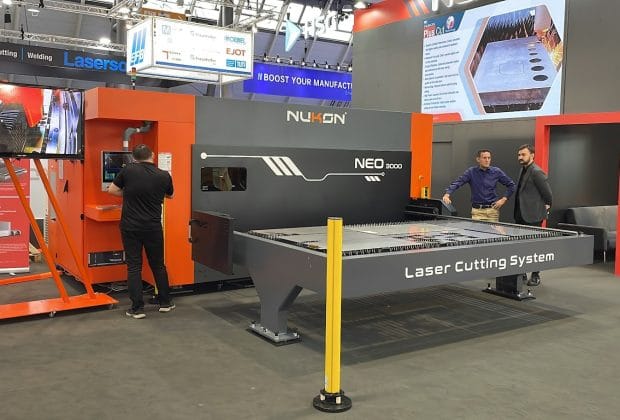
On a Nukon twin-pallet system (like the NEO, ECO, CROSS or Rex), this entire process happens outside the machine while the laser is already 30 seconds into the next job.
Industry data shows that a single-pallet machine is, on average, 40% less productive than a twin-pallet equivalent.
You are essentially paying for a high-speed fibre laser but only letting it run at “manual” speeds.
If you cut 10 hours a day on a twin-pallet Nukon, a single-pallet machine would likely only give you 6 hours of actual “beam-on” time for the same labour cost.
Over a year, that 40% gap represents hundreds of lost billable hours and thousands of kilograms of un-processed material.
The Nukon Approach: Smart Design over Sacrificed Speed
At Nukon, we design our shuttle table systems to be as integrated and streamlined as possible.
We believe that if you have the clearance to load a single-bed machine, you almost certainly have the space to run a NEO or ECO with a twin-pallet system.
By choosing the twin pallet, you aren’t just buying a second table; you’re buying the ability to keep your laser head moving.
In the world of fabrication, if the head isn’t moving, the machine isn’t making money.
Got a question for Steve?
Get in touch – sales@nukonlasers.co.uk
